Flexible Solar Cells
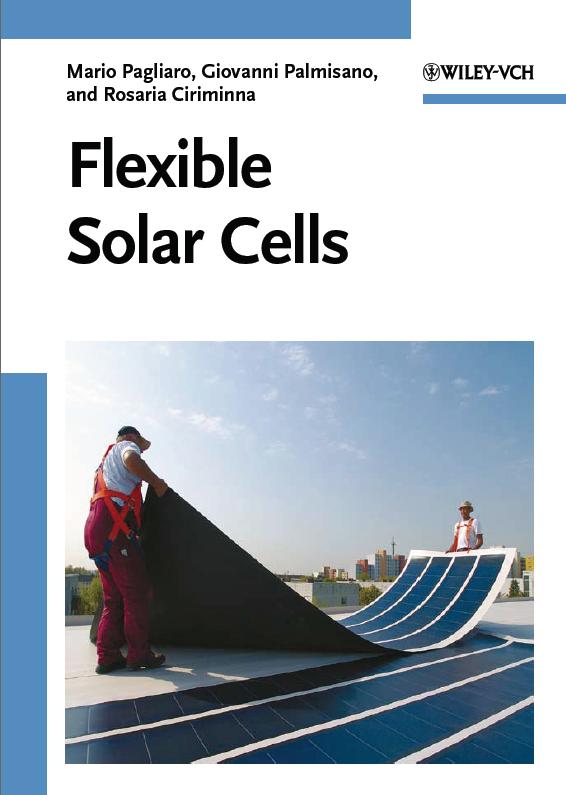 Book
Book
by
Mario Pagliaro,
Giovanni
Palmisano and
Rosaria
Ciriminna
Wiley-VCH, Weinheim, 2008
ISBN 9783527323753
Read the
review
of
Peter Lund in the
International Journal of Energy Research:
"Flexible Solar Cells can be warmly
recommended to everyone interested in solar electricity and its new
developments. This is a necessary reading to understand how solar
energy could grow from a marginal energy source today into a major
global energy player in the future".
This book deals with one of the hottest
fields of contemporary chemical and nanotechnology research:
Flexible solar cells based on inorganic and organic photovoltaics.
Written in a clear, concise style,
this book presents the scientific, technology and market aspects of thin-film
photovoltaics, in the context of concomitant developments made in
integrated PV-thermal technologies, and concentrated solar power
generation.
Readers of the book will find in a
single, updated volume plenty of relevant information.
Table of Contents
- Towards A Solar Energy
Revolution
- Flexible Solar Cells
- Why We are Entering the Solar Age
- Capturing Solar Light and Transferring Energy Efficiently
- Three Waves of Innovation
- Solar Design
- New Solar Companies
- References
- Photovoltaics
- How a Solar Cell Works
- The Solar Cell: A Current Generator
- Efficiency Limits of the Photovoltaic Conversion
- Multiple Junction Cells
- Photovoltaic Applications
- Brief History of Modern Photovoltaics
- References
- Inorganic Thin Film Solar Cells
- Thin Film: PV Technology for the Future
- Amorphous Si Thin Films
- CIGS Thin Films on Metal Foil
- CdTe Thin Films
- CIS Thin Films
- Environmental and Economic Concerns
- References
- Organic Thin Film Solar Cells
- Organic Solar Cells
- Bulk Heterojunction Solar Cells
- Optimisation of Organic Solar Cells
- Printed Plastic Solar Cells
- Brushing Plastic Solar Cells
- Power Plastic
- References
- Hybrid Thin Film Solar Cells
- Dye Solar Cells: A Versatile Hybrid Technology
- DSC at Work
- A Roadmap for Dye Solar Cells
- BIPV Through Dye Solar Modules
- Personalizing Solar Power
- References
- Emerging Technologies
- The Solar Paradox
- Quantum Well Solar Cells
- Nanostructured Solar Cells
- Graphene Solar Cells
- Nanorectennas
- References
- Helionomics
- Oil Peak Meets Climate Change
- Solar Enegy. Rewarding People, Rewarding Capital Markets
- Zero Emissions, Lean Production
- The Solar Energy Market
- PV Technology Trend
- Grand Solar Plans
- A New Manhattan Project?
- References
- Index
Translation in Chinese
The transalation of the book completed in late 2009, the Chinese version of
Flexible Solar Cells was
published by
Shanghai Jiao Tong University Press in January 2010.
Here is the message of the translator to the book's main author.
«Dear Professor Pagliaro,
«I'm
the Chinese translator of your book Flexible Solar Cells... I'd like to
thank you for your presenting us this wonderful book. It is
informative, up-to-day and enlightening. It takes two and a half months
for me to translate the book and I myself learned more about different
kinds of solar cells during the project.
«The
book will be published by
Shanghai Jiao Tong University Press in months. I got my BS from
Shanghai Jiao Tong University and MS from University of Central
Florida, US.
«My background is Physics and more
specifically Optics. However, I'm now in Photovoltaics and feel very
lucky to have the chance of translating your terrific book.
«I believe your book translation will be
very popular among Chinese readers, for the topic of flexible solar
cells is so hot, but available instruction of it is little. Thank you
for all you have done for the PV readers in the world and also in China!».
Yang Andrew Gao
(Shanghai Jiao Tong University Press, Shanghai)
Back to the Books Index
 Books
Books