 10-Feb-2026
 - "
Think out of the box, and look
for new chemical processes and for new products"
Professor
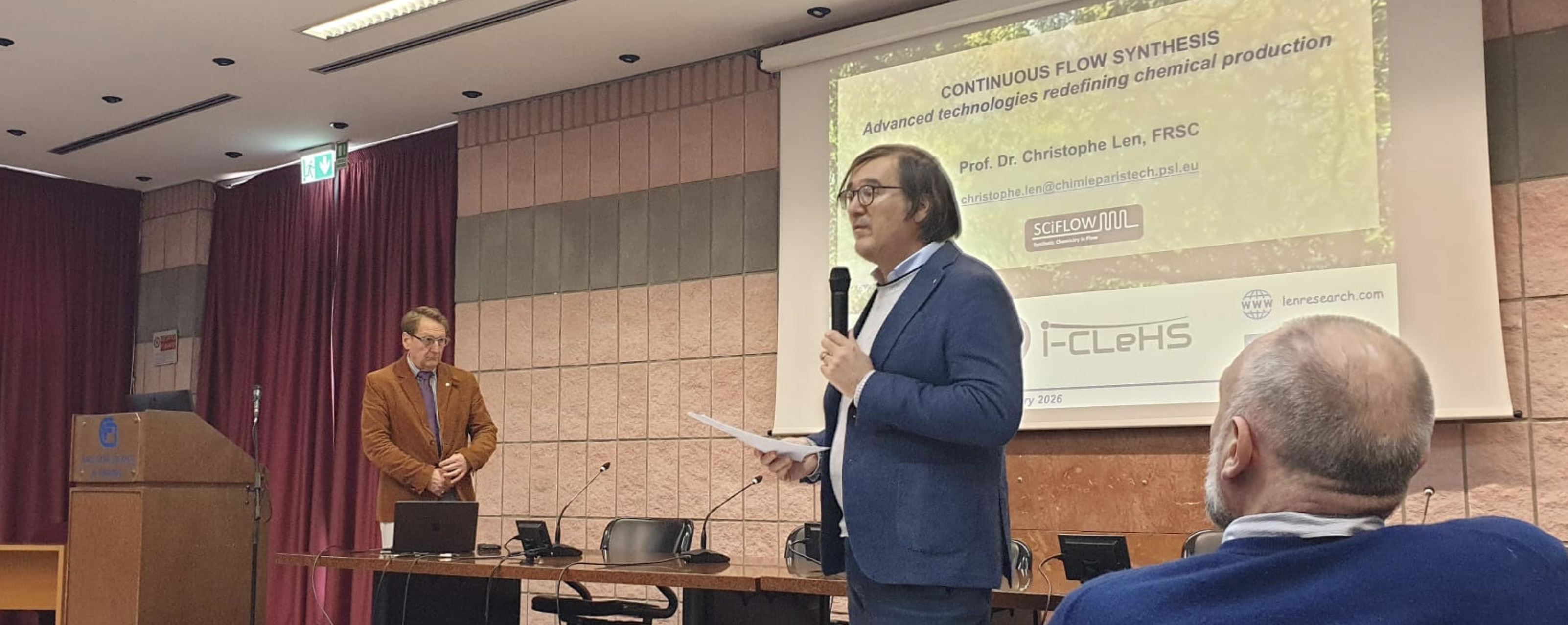
Christophe Len concluded his wonderful Seminar "
Continuous
flow synthesis: Advanced technologies redefening chemical
production" held today iat Italy's Research Council in
Palermo.
"
It is a pleasure to host Christophe in Palermo", said
Mario Pagliaro introducing the eminent
French scholar.
The Seminar is
freely
accessible online.
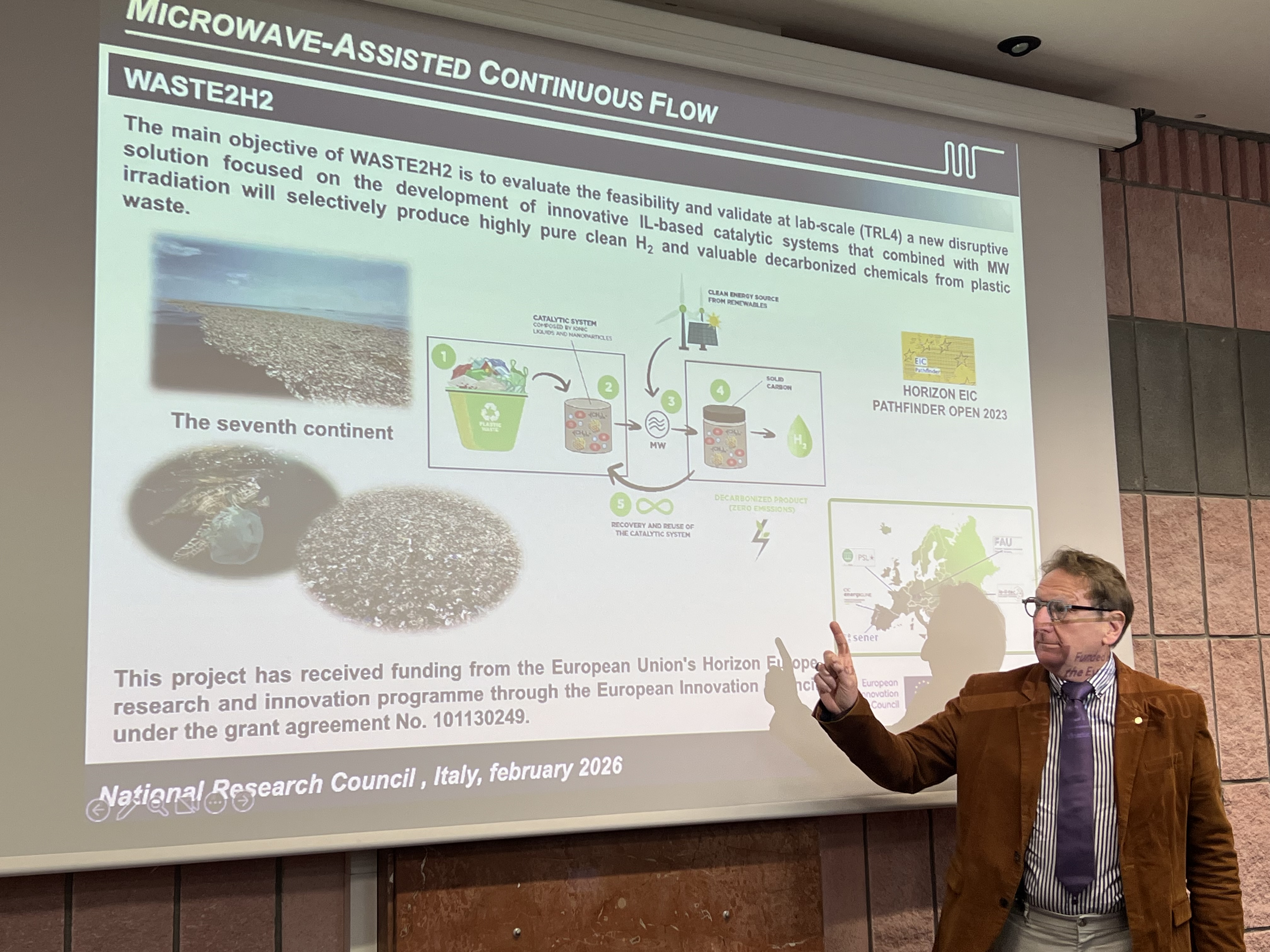
Amid the topics discussed, Professor Len presented the EU-funded
waste2H2 research project to
convert plastic waste into pure
clean hydrogen and carbon.
The French scholar started from entirely
waste-free
reductive
O-alkylation processes under flow developed by
his team at Chimie ParisTech, the École nationale supérieure de
chimie de Paris, in the Institute of Chemistry for Life and Health
Sciences.
The process for the
100% atom-efficient synthesis of
asymmetrical ethers proceeds over a Pd/C catalyst employng
hydrogen as only reductant in the reaction between an alcohol and
an aldehyde.
He continued with the clean synthesis of two active pharmaceutical
ingredients:
Propofol and Clonidine.
Hence, he presented a new equipment jointly developed with a Swiss
company
combining mechanochemistry with flow chemistry.
Beads are added to a flow reactor in which wheels turn at high
speed. Compressed beads transfer energy to solid reactants
enabling mechanichemical processes in so-called Impact in
Continuous Flow Heated Mechanochemistry (
ICHeM).
The scholar showed how the technology is now utilized for the
biphasic acetylation of glycerol with iacetic anhydride in the
presence of homogeneous acid catalysts
for
the synthesis of triacetin.
The
process so efficient and readily scalable that
production
will start next year in Saudi Arabia.
Honorary Professor at the
Xi’an Jiaotong University, China
(2022-2028) and Fellow of the Royal Society of Chemistry,
Professor Len since 2017 develops his research at Chimie
ParisTech.
His team's research focuses on
green synthetic organic
chemistry, and includes the conversion of biobased
molecules, homogeneous, heterogeneous and micellar catalysis, the
use of clean reaction media and of alternative reaction methods
such as microwave irradiation, ultrasounds, and continuous
manufacturing.
 News
News