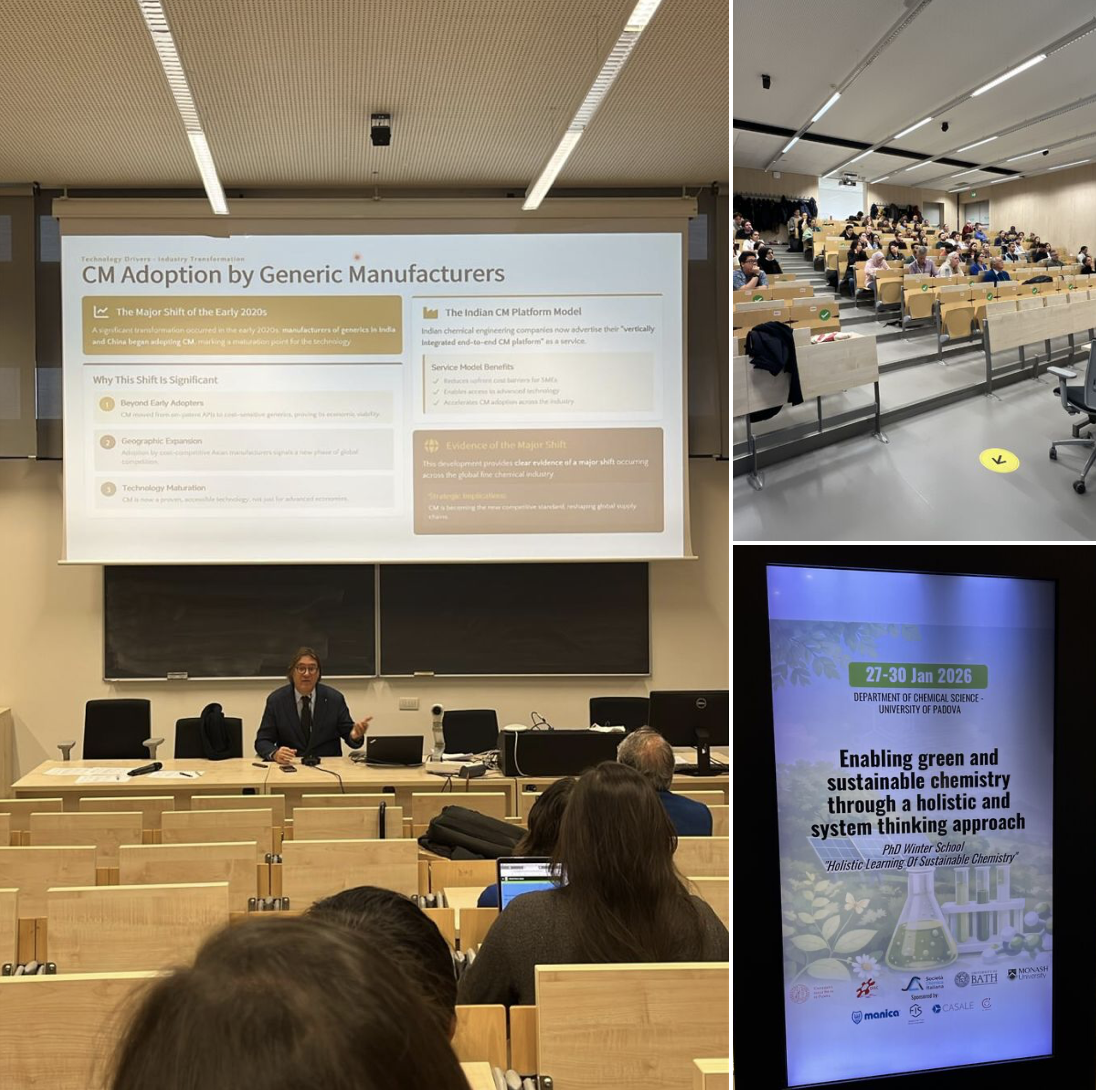
 28-Jan-2026
 - "The Fine Chemical Industry,
2000-2025" was the topic of the invited lecture given today by
Mario Pagliaro at PhD Winter School
"Enabling Green and Sustainable Chemistry through a Holistic and
Systems Thinking Approach".
Held
at the University of
Padua, Italy, from January 27 to 30, the School offered
a
broad and
interdisciplinary approach to
sustainable chemistry based on systems thinking
combining technical
insights with key topics such as life cycle analysis, circular
design, and the regulatory, social, and economic
implications of chemical production.
Following the same approach, Dr Pagliaro presented in his lecture
the
technology,
economic and
policy
drivers of change occurred in the fine chemical industry in the
first quarter of the 21st century.
"
It is no longer tenable" opened his lecture Dr Pagliaro "t
hat
PhD students in chemistry or in chemical engineering have a
sophisticated knowledge of specialized domains of chemistry
knowledge and they barely know the difference between fine and
specialy chemicals, knowing at the same time very little about a
huge and rapidly growing sector of the chemical industry such as
fine chemicals".
Following a brief presentation of the industry's history and
evolution, Italy's scholar went ahead presenting the organization,
production infrastructure, and global distribution patterns of
today's
fine chemical industry.
He thus identified catalysis, continuous manufacturing, and
digitalization as the
technology drivers of change; and
COVID-19, supply chain disruptions, and government responses as
the policy factors driving substantial changes in the structure of
the industry, including reshoring of fine chemical productions to
Europe, Japan, and North America.
He then presented selected case studies from India, China, France
and North America supporting his analysis.
Citing an editorial published in 1921 in
Nature, a
scientific journal published in Great Britain, for which "
our
future position depends upon our chemical ability, and hence
upon the employment of skilled workers directed by trained
chemists engaged in a successful organic chemical industry"
the Italian chemist concluded that the events of 2020-2022
confirmed that a
strong fine chemical industry is
fundamental to national security and public health of all
countries.
Hence, he concluded,
education of undergrduate chemistry
and chemical engineering students needs to be
reshaped to
include both practice-oriented training on the advanced chemical
technologies enabling growth and change in the industry, and
updated
teaching of the very same economic, regulatory, and social
implications of fine chemical productions preached by the
organizers of the HOLOS School.
The HOLOS PhD Winter School
Organized by the University of Padua with support Italy's Chemical
Society and chemical companies in collaboration with Monash
University in Melbourne and the University of Bath (Great
Britain), the School brought together in Padua, over four days,
76
participants and
28 international speakers.
Besides PhD students from the organizing
Universities, other doctoral candidates were from Germany, Great
Britain, Slovenia, and Switzerland.
Young
researchers too attended the School, including Giovanna Li
Petri and Giuseppe Angellotti from our Institute.
🇦🇺 19
participants from Monash University
🇮🇹 27
from the University of Padova
🇬🇧 2
from the University of Bath
🌐 19
additional PhD students from Italy, Europe, and beyond
🏭 7
participants from industry and research institutions
The
School
program combined lectures by leading experts with an
industrial forum held on Friday, alongside hands-on
workshops,
where five student groups participants teamed up to explore real
case studies and discuss challenges directly with specialists to
eventually offer a presentation of the projects, which sparked
numerous questions and comments:
• Hands-on group work on 5 real-world case studies, guided
by a systems-thinking methodology
• Strong engagement from students and facilitators,
culminating in high-level group presentations
• Industrial Forum fostering dialogue between academia and
industry
• Contributions from 28 lecturers across Australia, UK,
Italy, Germany, the Netherlands, and Switzerland
“
Context matters as much as chemistry, so that we can avoid
unintended consequences from widespread use of new chemistry
technologies” said University of Bath Research Fellow
Stephen
Salve Doliente, giving a talk about why systems thinking is
important in scaling up green chemistry technologies.
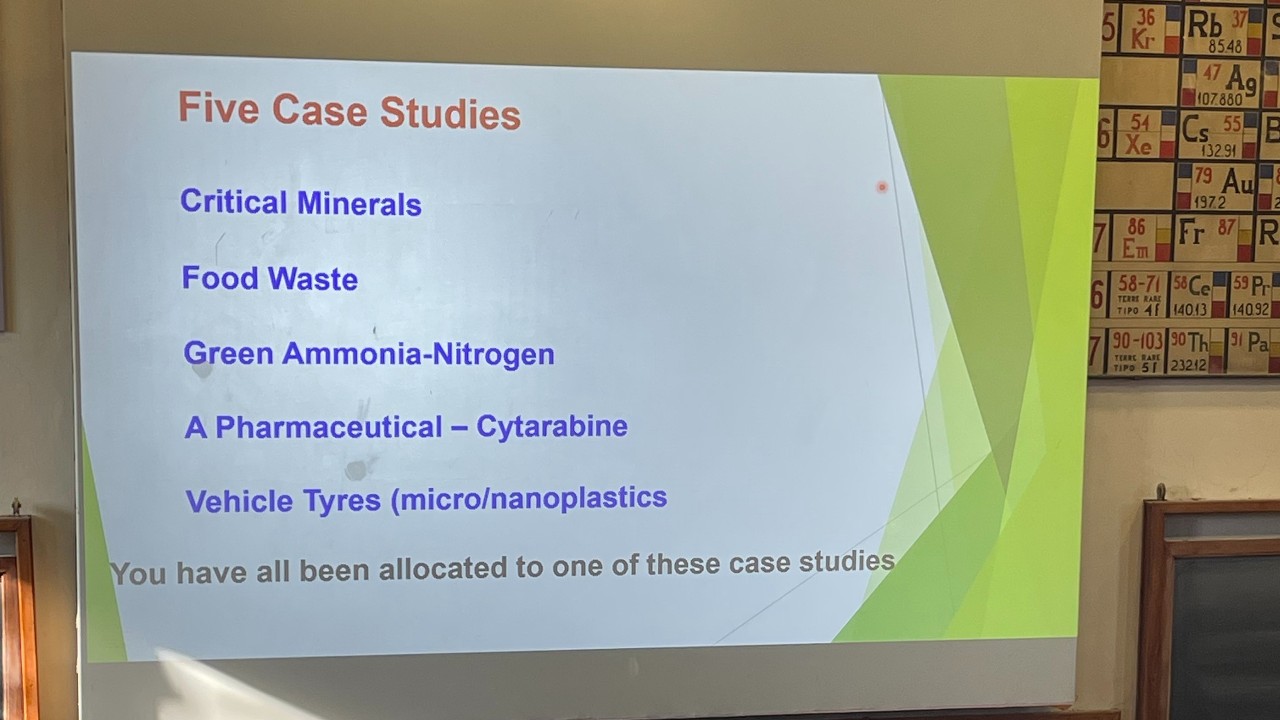
Five systems thinking/sustainable chemistry-oriented
case
studies - tyre microplastics, green ammonia, critical
minerals, food biomass and pharma. Each group was facilitated by
researchers from Monash Chemistry.
Professor Edward Buckingham nudged participant
to use
systems thinking to zoom in and out on the system to identify
leverage points for meaningful action.
Watch the
Photo
gallery.
 News
News