 1-Jul-2026
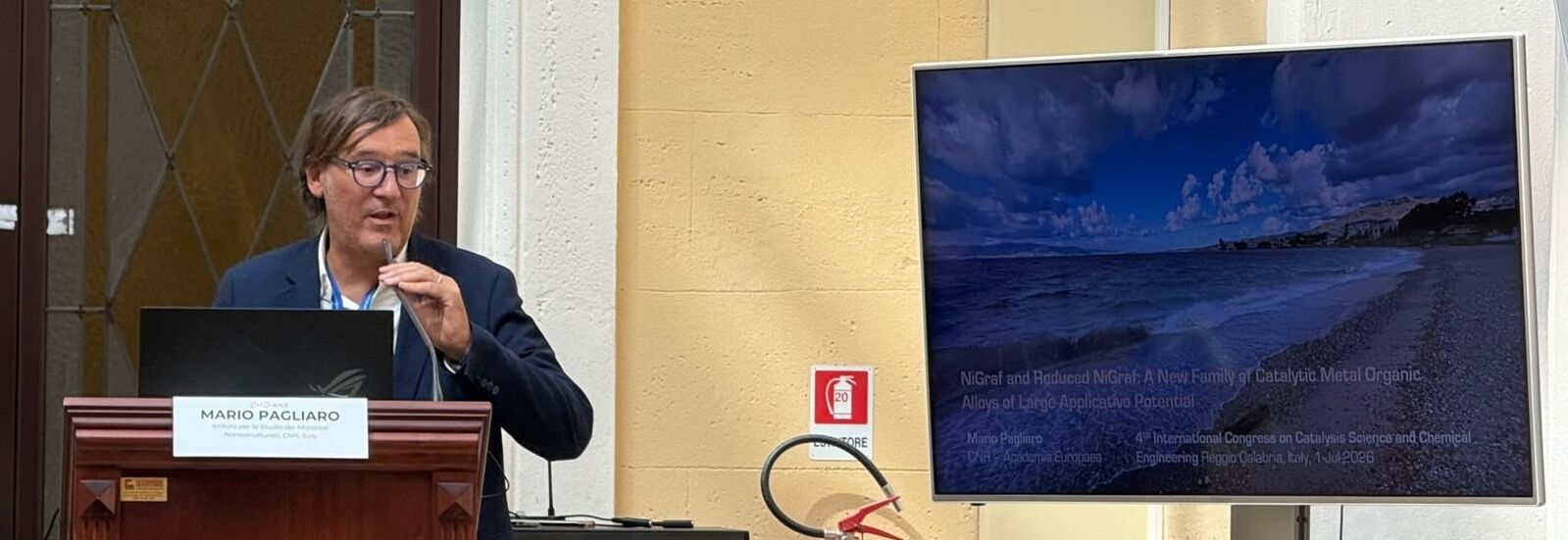
- Entitled "NiGraf and reduced NiGraf: a new family of catalytic
Metal Organic Alloys of large applicative potential", the invited
lecture of
Mario Pagliaro gave today one
of the keynote lectures at The Fourth International Conference on
Catalysis Science and Chemical Engineering (CatScience 2026) held
in Reggio Calabria, Italy, between June 29 to July 1, 2026,
"
I am particularly pleased to present at CatScience2026 in
homeland Calabria results jointly achieved with Cristina Della
Pina during Matteo Formenti's PhD at the University of Milan on
the use of reduced NiGraf in nitrobenzene reduction to aniline"
Dr Pagliaro opened his lecture..
Hosting lectures of eminent scholars including Qiang Zhang,
Kazunari Domen, Younan Xia, and Giancarlo Cravotto,
CatScience 2026
was attended by 73 delegates from 20 countries, with several
lectures and presentations of many other outstanding scientists in
catalysis, chemical engineering, and materials science.
Chaired by Professors
Francesco
Mauriello,
Emilia
Paone, and
Rafael
Luque, the three-day Conference hosted researchers from
academy and industry who will share insights into recent
scientific developments and technological advances at crossroad of
chemistry, chemical engineering, and materials science.
Dr Pagliaro spread news about the conference's presentations using
two social media (Twitter and Linkedin).
Università degli Studi di Torino's Professor
Giancarlo
Cravotto addressed new green technologies in both catalyst
manufacturing and organic processes.
"
How do we define what is sustainable in chemistry and what is
not? Think in terms of shades of greeness in organic synthesis
and catalysis" sad Università degli Studi di Perugia
Professor
Luigi
Vaccaro opening his lecture.
"Reframing the Amazon" was a bioeconomy research insight into the
world's largest pluvial forest seen both as a biodiversity
reservoir and a global platform for bioproductions given by
Universidade Federal do Paraná Professor
Luis
Adriano Santos do Nascimiento.
IIT Hyderabad's
Sundarsaman
Putla presented several new results of
plastic waste
upcycling using new catalytic processes and catalysts.
University of Calabria's Professor
Bartolo
Gabriele gave a spectacular presentation on oxidative
carbonylation mediated by Pd iodide.
Day 3 of CatScience2026 opened with a brief address from the
Conference chairs on the founder of the University of Reggio
Calabria, Professor
Rosario
Pietropaolo, on the fourth anniversary of his passing.
Quentin
De Roover from Université de Liège presented excellent
results on new,
fully aqueous LiCl-based electrolyte for
new generation Li-ion batteries.
Ruhr-Universität Bochum's Professor
Lars
Borchardt started his presentation mentioning Ostwald's 1909
The Fundamental Principles of Chemistry' :"
Therein
he introduced the word mechanochemistry to indicate a mechanical
energy input driving a chemical reaction".
Professor
Kazunari
Domen explained how, following the world's first lage (100
m2)
solar hydrogen production plant using relatively small
photocatalyst panels installed at the University of Tokyo,
his team is building a 5,500 m2 solar hydrogen plant using two m2
photocatalyst panels in Ilda City, Japan.
Johns Hopkins University's Professor
Younan
Xia reminded the audience about the importance of
metal
nanoparticle shape, and its mechanistic control, to achieve
substantial improvements in catalysis.
"
Energy storage is key to the energy transition", sad
Tsinghua University's Professor
Qiang
Zhang opening his lecture "
and chemistry innovation is
making it economically and technically viable, starting from
China which is the world's largest useful energy consumer".
He showed also how his team uses AI-controlled robots to speed up
identification of new, cleaner (and safer)
electrolytes for
Li-ion batteries, able to enhance the overall battery performance
(energy density, cycle life, rate capability).
University of Bologna's Professor
Fabrizio
Cavani opened the conference presenting his team's
achievements in
catalysis for biobased chemicals and fuels
(including aviation fuels).
Overall,
CatScience 2026 (
event
photos) was a great scientific conference raising the
interest of both delegates and researchers following the
conference from far away. In j
ust one week between June 29
and July 5, our posts on a social media (linkedin) covering the
conference received
17,247
views, 8 comments and nearly 600 "reactions", showing
evidence of the
effective use of
social media for research chemists.
Previous editions of CatScience were held in Budapest (2025),
Valencia (2024), and Melbourne (2019).
 News
News